





by Denis Tetreault
Version 2.11
The idea of a special "world beneath the world", a dark, mysterious
place isolated from the surface world of the player characters and filled with
natural wonders and ancient evils, was first introduced to D&D players and
DMs as the D-Series of modules (D1 Descend into the Depths of the Earth, D2
Shrine of the Kuo-Toa, and D3 Vault of the Drow) first published in 1978, and
later reprinted in 1986 as the GDQ1-7 Queen of the Spiders supermodule. This
new subterranean world was based in the World of Greyhawk. Since then, much
has been written about this "underdark" realm, both set in specific
worlds (such as the Forgotten Realms) and as generic writings, as numerous adventure
modules, magazine articles, and hardcover rulebooks for every edition of D&D
since. The popularity of the setting even spawned a series of highly popular
novels by R.A. Salvatore about Drizzt, a drow ranger from the Forgotten Realms.
This section of my website will strive to present material about Greyhawk's
underdark, sometimes referred to as "DeepOerth". The material here
could also be easily adapted by DMs to fit into any campaign world they choose
to use.
This is a Dragonsfoot community project discussed at the Collaborative
Project: Mapping the Depths of the Earth forum (originally proposed
by PapersAndPaychecks in May 2005, and kicked off by Gnarley Bones, in July
2006) to detail all of the remaining areas on the map provided in D1 Descend
into the Depths of the Earth, and that were not described in the original D-series
modules. The last compilation of the project, edited by Iain_IF in 2008, can be downloaded
as the "Encyclopedia Subterranica"
here. Check back for updated versions as the project proceeds. Eventually,
a finalized document will be available here and on the Dragonsfoot website.
As time passed, it became clear that a continually updated compilation volume was not tenable for a variety of reasons, though updates of individual encounter areas could be accomplished, so I created this page. Below is a new index map of the area. DM's can click on an encounter area on the map (or
the chart below) to view a PDF of the single encounter description, if a completed one is
available. Hovering over the encounter areas with your mouse in the index map
below will bring up pop-up text with the name of the encounter. For the incomplete encounters, check the compilation volume where some can be found, others were never released. I will continue to attempt to get those out, if I have materials from the original authors, or I can get in contact with them.

For a high-resolution (1500x2166) version of the index map suitable for printing, please click here.
The collaborative project is indeed a massive undertaking, consisting of contributions from 20 different authors. The current state of the project is summarized below. Completed encounter areas are available as part of the compilation volume, and will become available as separate files accessed off the index map above (by clicking on each corresponding map location) and from the chart below, as the individual PDFs are being created. Other encounter areas will become available as the authors complete them. Check back to see how things are going.
| Coordinates | # of Hexes |
Encounter Name | Creator | Status | |
| 001 | B/9 | 1 |
Trading Post of the Dead, Dying, Damned, and Doomed Dwarves! | Predavolk | Complete |
| 002 | B/30-31 | 2 |
The Duergar Redoubt | Eldersphinx | Complete |
| 003 | C/19 | 1 |
The Duergar Guardpost | SoulCatcher78 | Complete |
| 004 | D/3 | 1 |
Drow Checkpoint | Gary Gygax | Module D1 |
| 005 | E/15-F/16 | 2 |
The Moaning Chasm | SoulCatcher78 | Complete |
| 006 | F/35 | 1 |
Obsidian Pool of the Fallen Star | jmidd | Need Map |
| 007 | I/18 | 1 |
Bugs | Iain_IF | Complete |
| 008 | I/25 | 1 |
Purple Worm Warren | Michael Sandar | Incomplete |
| 009 | J-K/31 | 2 |
The Repository of Lost Souls | Xiuhcoatl "Xi" | Incomplete |
| 010 | K/4 | 1 |
The Captive Pech | Istarlome | Complete |
| 011 | L-M/19 | 2 |
The Trading Grounds | Eldersphinx | Need Map |
| 012 | M/12 | 1 |
Mind Flayer Spy Post | Gary Gygax | Module D1 |
| 013 | N/38-39 | 2 |
Kuo-Toan Town | wbeatty | Incomplete |
| 014 | O/10 | 1 |
Cleanup Crew | Eldersphinx | Complete |
| 015 | Q/18-19 | 2 |
The Caverns and Warrens of the Troglodytes | Gary Gygax | Module D1 |
| 016 | Q/32 | 1 |
Hidden Shrine to the Elder Elemental God | wbeatty | Incomplete |
| 017 | R/9 | 1 |
Wererats' Warren | Eldersphinx | Complete |
| 018 | S-T/17 | 2 |
The Ghoul Warrens (map held by ghouls and ghasts |
Marco | Complete |
| 019 | S/27 | 1 |
Stone Giant Mining Project | thenraine | Complete |
| 020 | T/40 | 1 |
Shadows in the Darkness | Runecrow | Complete |
| 021 | U/13-14 | 2 |
At the Gate of Da-mur-shou (A Mind Flayer Outpost) | Runecrow | Need Map |
| 022 | W/22 | 1 |
Mice in the Lab Maze | Disjected | Complete |
| 023 | W/27 | 1 |
Thoopshib's Barge Crossing | Gary Gygax | Module D2 |
| 024 | X-A2/43-45 | 6 |
The Forsaken City of Naavros | Eldersphinx | Need Map |
| 025 | Y/26 | 0 |
The Dread Sinkhole | Eldersphinx | Need Map |
| 026 | Y/36 | 1 |
|||
| 027 | Z-A2/35 | 2 |
The Secret Garden | wbeatty | Complete |
| 028 | A2/20 | 0 |
The Fire Giant Ambush | Istarlome | Complete |
| 029 | A2/31 | 1 |
Svirfneblin Prospecting Claim | Gary Gygax | Module D2 |
| 030 | B2/14 | 1 |
|||
| 031 | B2/24 | 0 |
Svirfneblin Trading Post | Elfdart | Complete |
| 032 | C2/20 | 1 |
The Fire Giant Lair | Istarlome | Complete |
| 033 | E2/24 | 1 |
The Lava Fissure | Istarlome | Complete |
| 034 | E2/43 | 1 |
|||
| 035 | F2/29 | 1 |
Grotto of the Morkoth | Eldersphinx | Need Map |
| 036 | I2-J2/34-35 | 2 |
Bodanay | ||
| 037 | I2-J2/47-48 | 2 |
The Fungi Caverns | Gnarley Bones | Incomplete |
| 038 | J2-K2/26-28 | 6 |
The Svirfneblin Stronghold | Istarlome | Incomplete |
| 039 | L2/31 | 1 |
Sanctum of the Absent Mage | Eldersphinx | Complete |
| 040 | L2/41-42 | 2 |
Shrine of the Kuo-toa | Gary Gygax | Module D2 |
| 041 | M2-N2/18 | 2 |
|||
| 042 | N2-O2/51 | 2 |
The Drowad Caverns | Papers and Paychecks | Complete |
| 043 | O2-P2/23-25 | 6 |
The Ancient City of Khor | Maldin | Complete, future website expansion |
| 044 | Q2/49 | 1 |
Gateway to the Vault of the Drow | Gary Gygax | Module D3 |
| 045 | R2/28 | 1 |
The Forbidden Cavern | Maldin | Incomplete |
| 046 | R2/47 | 1 |
Grotto of Silussa and Belgos | Gary Gygax | Module D3 |
| 047 | S2/30 | 0 |
The Smugglers | Elfdart | Complete |
| 048 | S2/33 | 1 |
Beware the Lord of Eyes | grodog | Complete |
| 049 | U2/32 | 0 |
White Goblin Ambush | Elfdart | Complete |
| 050 | U2/48 | 1 |
Black Widow Guardians | Gary Gygax | Module D3 |
| 051 | W2-X2/27-28 | 2 |
Papers and Paychecks | Incomplete | |
| 052 | W2/31 | 1 |
Mock26 | ||
| 053 | W2-Y2/44 | 3 |
The Chasm of Deadly Breath | Eldersphinx | Complete |
| 054 | X2/37-38 | 2 |
Realm of the White Goblins | Elfdart | Incomplete |
| 055 | Y2-Z2/54-57 | 6 |
The Vault of the Drow, the City of Erelhei-Cinlu | Gary Gygax | Module D3 |
| 056 | Z2-A3/24-25 | 4 |
(Isle on the Sunless Sea) | Papers and Paychecks | Incomplete |
| 057 | The Ursinians | Terry | Need Map | ||
| 058 | Escaped Slaves | Disjected | Need Map | ||
| 059 | The Brazen Tower | Eldersphinx | Need Map | ||
| 060 | random encounters | Bodanay |
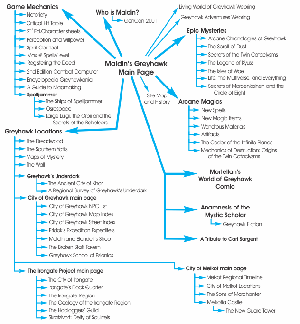
Visit my active site map to see the entire website
at-a-glance, find out whats new, and instantly jump there with just a
click.
Return to the Greyhawk Locations
Page
Return to my main Greyhawk Page
(in case you got here through a search engine)
